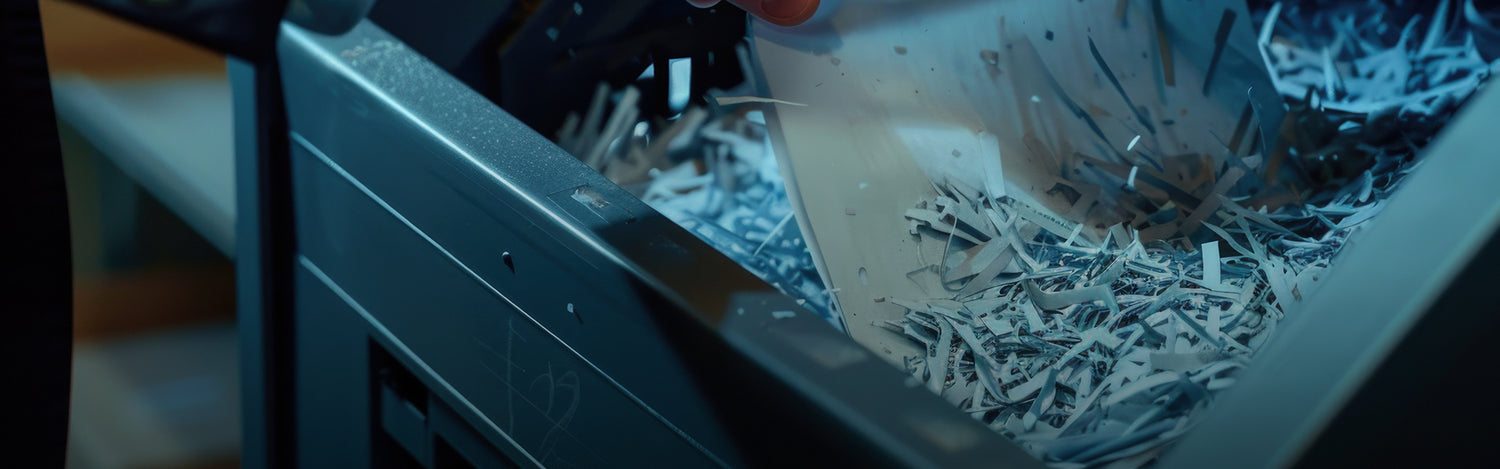

A shredding machine that jams every day or has worn-down blades can’t keep up with your business’s operations. But why are these issues happening? When you know which mistakes to avoid when buying an office document shredder, you will have a machine that keeps up with the workflow.
Picking the Wrong Shred Size
Security level should shape the model your office chooses. Many businesses pick a strip-cut shredder because it’s simple, then they realize the shreds reveal too much information. Offices that handle payroll records, personnel files, invoices, or client documents need a small particle size.
Cross-cut models are a great alternative. The paper shreds fall between a particle size of about 5/32 inch by 1 1/2 inches down to about 1/32 inch by 7/16 inch. The size will depend on the shredder’s security level. Each model is different, so it’s necessary to read through each specification to determine which shredding size and style is ideal for your office.
Going Above the Sheet Capacity
Many offices run into problems because they treat the listed sheet capacity as a suggestion. Once people push the shredder past its limit, jams happen frequently, and the motor works overtime. The result is poor cutting performance and a decreased service lifespan.
Buyers should look at sheet capacity with daily habits in mind. Determine the average number of sheets the office shreds each day. The shredder most likely won’t accommodate over 50 sheets at a time. However, choosing a sheet capacity of anywhere between 10 and 30 sheets will suffice. Just remember to avoid overloading the machine and give it time to cool down between sessions.
Overlooking Cutting Blade Maintenance
Another common mistake people make when buying an office document shredder is failing to care for the cutting blades. Some office document shredders have an auto-oiling feature, so the blades are always lubricated. However, if you choose a machine without this characteristic, you’ll need to manually oil the blades.
Employees can feed shredder oil sheets through the machine. An alternative is to apply bottled shredder oil in a zigzag pattern across a sheet of paper and run that sheet through the cutters.
Failing To Consider Bin Capacity
A bin overflowing with paper shreds is likely to cause jams. Emptying the bin regularly is an essential maintenance task, but considering the bin size before purchasing a shredder will make the office run smoothly.
Use the average number of sheets the office shreds daily to come to a decision. High-volume operations may need a bin size of 30 gallons or more, while low-volume shredding may only require a bin under 20 gallons.
Choose a Model That Fits the Workflow
A dependable shredder should match daily volume. Capital Shredder offers numerous midsized paper shredders that help offices discard sensitive information without hindering the workflow. Browse our wide range of options to find the model that fits your security, bin size, and shred size requirements.